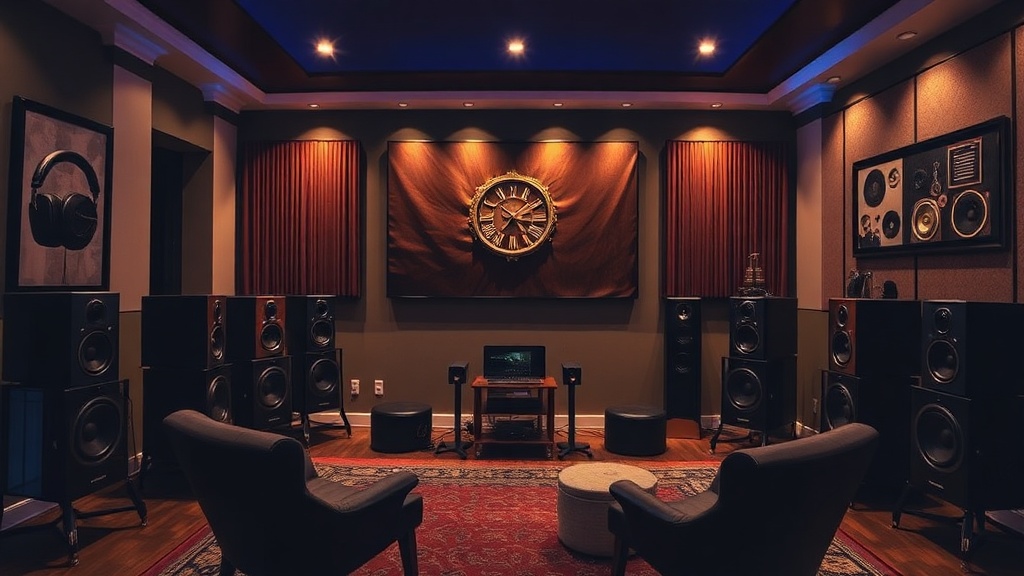
Setting Up a Dedicated Listening Room for Analog Audio

Why high-end speakers aren't the only factor in sound quality
Most people think that if they want a better listening experience, they simply need to drop a few thousand dollars on a pair of premium monitors or floor-standing speakers. It's a common mistake. You can own the most expensive gear on the market, but if your room is fighting against the physics of sound, you're essentially throwing money away. Sound is a physical wave; it bounces, vibrates, and reacts to every surface it touches. If you're listening in a room with bare hardwood floors and high ceilings, those expensive waves are bouncing around like a pinball machine before they ever reach your ears. This isn't just about volume—it's about clarity, depth, and the ability to actually hear the texture of a vinyl record's groove.
A true analog enthusiast knows that the room is the final component in the signal chain. You aren't just listening to a record; you're listening to the record, the turntable, the amplifier, the speakers, and the room itself. If the room is untreated, it's a broken link in that chain. Achieving a balanced sound requires more than just expensive hardware; it requires a strategic approach to how sound behaves in a confined space.
How do I treat my room for better audio-visual experiences?
Treating a room doesn't mean you have to turn your living room into a professional recording studio that looks like a padded cell. There's a massive spectrum between a bedroom with nothing but a bed and a professional studio. The goal is to manage reflections. When a sound wave hits a hard surface, it bounces back—this is called a first reflection. If these reflections are too strong, they create a messy, smeared sound. You'll notice that the vocals might sound "blurry" or the percussion feels disconnected from the music.
The first thing you should address is the "first reflection points." These are the spots on your side walls where the sound from your speakers hits before it reaches your ears. You can find these using the mirror trick: sit in your listening position and have someone slide a mirror along the wall. Wherever you see the reflection of the speaker, that's where you need to place an acoustic panel. These don't have to be thick, professional-grade panels. Even heavy velvet curtains or a bookshelf filled with books can help diffuse sound waves. A bookshelf is actually a fantastic tool—the irregular shapes of the books break up the sound waves, preventing them a single, harsh echo from returning to your ears.
To learn more about the physics of sound waves and how they interact with surfaces, the Sound Science resources are a great place to start. Understanding the difference between absorption and diffusion is the first step to a better setup.
What kind of floor-standing vs bookshelf speaker setup works best?
Choosing between bookshelf and floor-standing speakers is often a debate about space and frequency response. Bookshelf speakers are often overlooked as "entry-level," but in a smaller room, a pair of high-quality bookshelf speakers on dedicated stands can actually outperform a massive floor-standing model that is overwhelming the space. If your speakers are too big for the room, the bass will become a muddy mess that drowns out the mid-range frequencies.
- Bookshelf Speakers: Great for smaller rooms or desktop setups. They offer precision and can be placed at ear level easily.
- Floor-standing Speakers: Best for larger, open-concept spaces where you need more low-end authority and a wider soundstage.
The key is the relationship between the speaker and your seating. If you're using a bookshelf speaker, don't just sit it on a wooden desk or a flimsy shelf. The vibration from the music can rattle the surface, causing unwanted noise. Use isolation pads or dedicated stands to decouple the speaker from the furniture. This ensures that the vibration stays in the speaker and doesn't turn your desk into a giant, vibrating tuning fork.
Can I improve my vinyl playback without new gear?
Before you go out and buy a new cartridge or a more expensive preamp, look at your environment. Many people blame their turntable for a "thin" sound when the actual issue is the surface the turntable is sitting on. A turntable is a sensitive instrument that reacts to every vibration in the room. If your turntable is sitting on a shelf that is also holding a heavy stereo receiver, the heat and the vibrations from the receiver can negatively impact your playback.
One of the cheapest ways to improve your analog experience is through decoupling. This means physically separating your gear from any source of vibration. Use heavy-duty isolation feet or even a specialized heavy-duty mat under your turntable. This minimizes the amount of mechanical energy that can disrupt the needle as it tracks the groove. For more technical advice on turntable maintenance and setup, the Vinyl Engine community offers incredible deep dives into the mechanical aspects of playback.
You should also consider the "stereo image." This is the sensation that the music is coming from a three-dimensional space rather than just two boxes. To get a better image, you need to experiment with the "toe-in." This is the angle at which your speakers point toward your ears. Sometimes, pointing them slightly toward you improves the clarity of the center image, while slightly angling them outward can broaden the soundstage. It's a process of trial and error that doesn't cost a dime.
Don't forget about the cables, too. While "audiophile cables" are a controversial topic, the quality of your connections matters. Ensure your wires aren't tangled or creating electromagnetic interference near your power cables. It's a small detail, but in a dedicated listening room, every little bit of signal integrity counts toward that much-needed clarity.